
Residential service
EV charger installation in Houston
We install Level 2 chargers on a dedicated 240-volt circuit, after confirming your panel can carry the load.
What EV charger installation includes
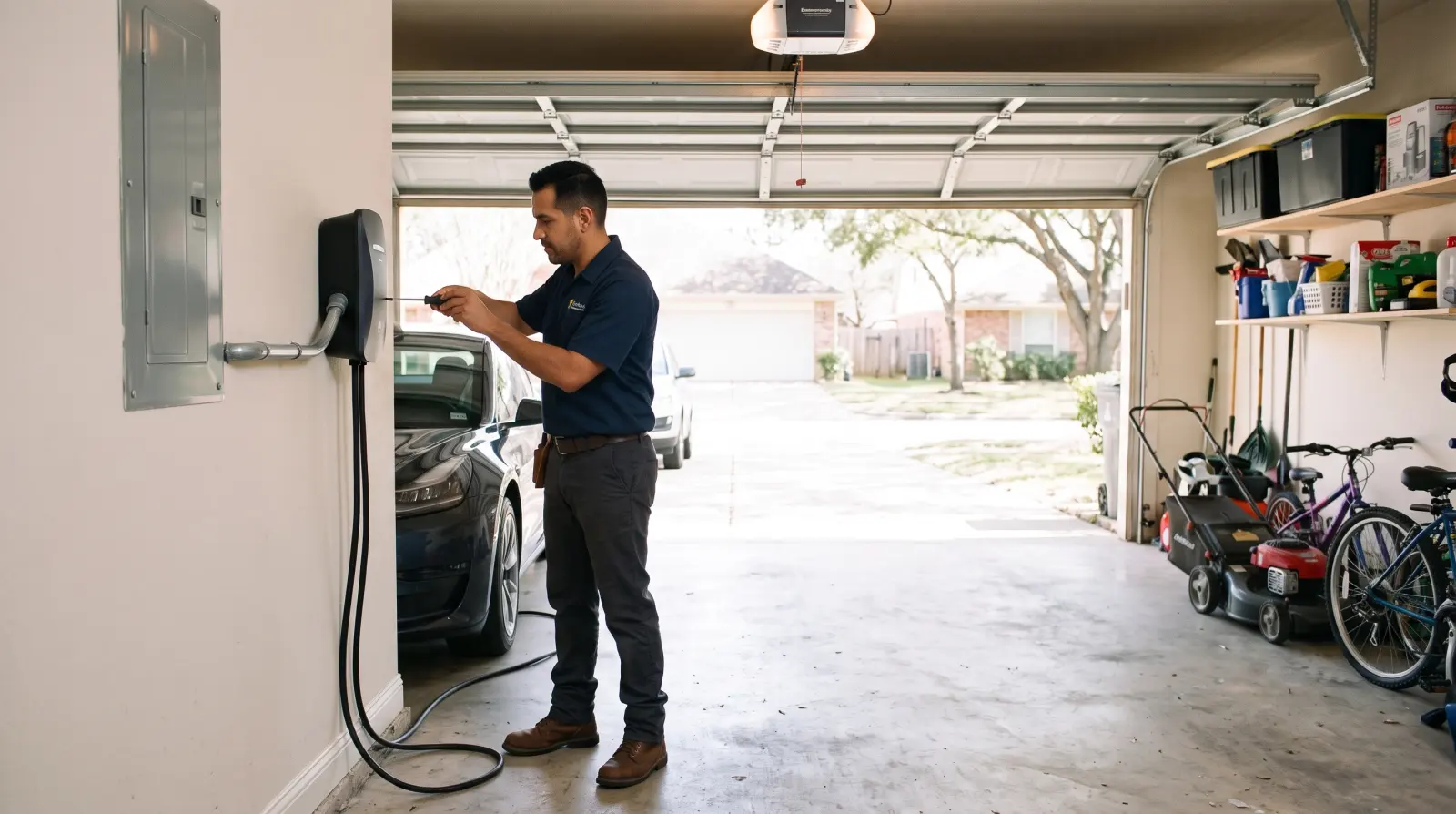
A Level 2 charger runs on 240 volts, the same voltage as an electric dryer, and charges most electric vehicles overnight. Installing one means adding a dedicated circuit from your panel to the garage or driveway, sized for the charger, and mounting and connecting the unit.
Before anything is installed we calculate the load on your panel. If there is room, the charger goes on a new breaker. If there is not, we explain the options: a load management device, a lower charging rate, or a panel upgrade.

When a home charger makes sense
- You charge from a regular 120-volt outlet and it does not keep up with your driving.
- You are buying or leasing an electric vehicle and want charging ready on day one.
- You rely on public chargers and want to charge overnight at home.
- Your household is adding a second electric vehicle.
- You have a charger but the breaker trips or the cable gets hot.
How the work goes
Panel check
We review your panel, on site or from a photo, and calculate whether it can carry the charger.
Location and estimate
We agree on where the charger goes and give you a written price for the circuit and the installation.
Permit
We file the electrical permit for the new circuit.
Installation
We run the dedicated 240-volt circuit, install the breaker, and mount and connect the charger or the outlet for it.
Test
We test the charger with your vehicle when possible and show you how it works.
How long it takes
A typical installation near the panel takes a few hours. Longer cable runs, exterior locations or a panel that needs work first add time.
Permits and inspections
Yes, a permit is required. A charger needs a new dedicated circuit, and new circuits require an electrical permit and an inspection in Houston and the surrounding jurisdictions.
What affects the price
The charger itself is only part of the cost. The installation price depends on:
- The distance from the panel to the charger location.
- Whether your panel has the capacity and the breaker space.
- Hardwired charger versus a 240-volt outlet.
- The charging rate (amperage) you want.
- Indoor versus outdoor mounting, and any trenching or conduit.
- Whether you supply the charger or we do.
Frequently asked questions
Do I need a panel upgrade for an EV charger?
Not always. Many 200-amp panels can carry a Level 2 charger. With 100-amp service it is more likely, but a load calculation gives the real answer.
What is the difference between Level 1 and Level 2 charging?
Level 1 uses a standard 120-volt outlet and adds a few miles of range per hour. Level 2 uses 240 volts and charges several times faster, enough to refill most vehicles overnight.
Should the charger be hardwired or plugged in?
Hardwired is the more durable connection and allows higher charging rates. A plug-in unit is easier to replace or take with you. We explain both for your charger model.
Can you install a charger I already bought?
Yes. Tell us the brand and model so we can size the circuit correctly.
Can the charger go outside?
Yes, with a charger and fittings rated for outdoor use.